Article
Livestreaming · 6 min read
Livestreaming may look simple from the audience’s side. They open Facebook, YouTube or another platform, see a live video and follow the event as it happens.
Behind a professional live broadcast, however, there is much more than connecting a camera to the internet and clicking “Go Live.”
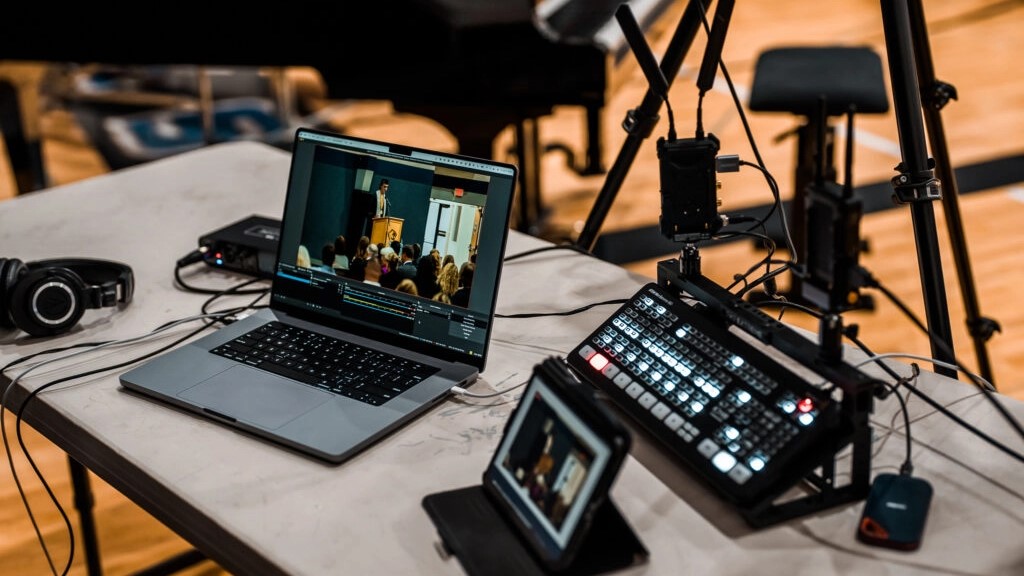
A reliable livestream is a complete production system. Cameras, audio, switching, graphics, internet connectivity, encoding, monitoring, recording, backup systems and the production team all have to work together.
From my experience working on live productions, including the JIBWIS Conference and MULAN Conference, I have learned that successful livestreaming depends as much on preparation and decision-making as it does on equipment.
Professional Livestreaming Is More Than a Camera
One common misconception about livestreaming is that better cameras automatically produce a professional broadcast.
Cameras matter, but they are only one part of the system.
A professional production may involve several cameras covering different perspectives, microphones and an audio mixer, a video switching system such as vMix or another production switcher, graphics and presentation sources, an encoder, reliable internet connectivity, monitoring displays and recording systems.
The objective is not simply to send video to the internet. It is to produce a coherent programme that gives the online audience a controlled and professional viewing experience.
This is one reason multi-camera production can make such a significant difference. A wide shot can establish the venue, another camera can concentrate on the speaker, while another provides close-ups, alternative angles or audience reactions.
Scene Changing and Multi-Camera Production
One area I consider particularly important is scene changing and multi-camera production.
Professional switching is not about changing cameras simply because several cameras are available. The person controlling the production has to follow what is happening and decide which source should be on air at each moment.
During a conference, for example, the appropriate shot may change from a wide view of the hall to a close-up of the speaker, a presentation source, a participant or another part of the programme.
Those decisions happen in real time.
There is no opportunity to stop the event and repeat an important moment because the wrong camera was selected. This is why preparation, concentration and understanding the programme matter in live switching.
Audio Deserves the Same Attention as Video
A livestream can have excellent pictures and still feel unprofessional when the sound is poor.
Audio therefore has to be treated as part of the main production design, not as something to solve after the cameras have been installed.
The production team needs to understand where the sound is coming from, how it reaches the livestream, how it will be monitored and what happens if the primary audio path fails.
This becomes particularly important at conferences and hybrid events, where the sound being heard inside the venue may not automatically be the same mix required by the online audience.
Reliable Internet Is Part of the Production Equipment
Internet connectivity should not be treated as an external detail. It is part of the broadcast infrastructure.
A production team may have good cameras, professional audio and excellent switching, but an unstable connection can still damage the entire livestream.
For important productions, the team should understand the available connection, test it before the programme begins and consider what alternative path is available if the primary connection fails.
The same principle applies to the rest of the production. What happens if a camera stops working? What if the streaming computer develops a problem? What if a cable or another important source fails?
Thinking about these possibilities before going live is part of professional preparation.
The Pressure Behind a Live Production
There is also a human side of livestream production that people watching from home rarely see.
Before an important production, I personally find myself thinking deeply about the job: how the production will begin, how the different components will work together, what could go wrong and how we can reach the end successfully.
That concern pushes me to think about the production from beginning to end.
Unlike recorded content, a live event gives you limited opportunity to correct mistakes after they happen. The audience is watching the decisions of the production team in real time.
This is why preparation matters.
Equipment Remains a Real Challenge
Another challenge I have observed is access to sufficient professional equipment.
Knowing how a production should be done does not automatically mean that every required piece of equipment will be available.
Cameras, lenses, tripods, switching systems, audio equipment, computers, capture devices, monitors, cabling, communication systems and backup infrastructure can quickly increase the resources required for a serious production.
The solution is not necessarily to wait until you own every piece of equipment.
A developing professional can start by building knowledge and practical experience, understanding what each component contributes to the workflow, and gradually finding realistic ways to access or acquire the equipment required for the level of work being undertaken.
We Need More Hausa Professionals in This Field
From my own observation, professional livestreaming and digital broadcast production is still an area where I would like to see greater participation from Hausa professionals.
This matters because the need for quality digital broadcasting now extends beyond conventional television stations.
Conferences, organisations, educational institutions, religious programmes, businesses and other events increasingly need their programmes to reach audiences online.
That creates opportunities not only for content creators, but also for people who understand the technical and production side of digital media.
Livestreaming can itself become a professional specialization.
Knowledge Should Come Before Equipment
My advice to anyone who wants to move from ordinary livestreaming into professional production is straightforward:
Seek knowledge first.
Learn how live production works. Understand cameras, audio, switching, signal flow, streaming software, internet requirements and the relationship between the different components of the production.
Then begin finding ways to access and gradually acquire the equipment that will allow you to meet the requirements of the jobs you want to undertake.
Buying equipment without understanding the production process does not automatically make someone a professional.
Knowledge allows you to understand why you need a particular tool, when you need it and how it should fit into the wider production system.
Professional Livestreaming Is a System
Ultimately, professional livestreaming should be understood as a system rather than a single piece of technology.
The cameras matter. The audio matters. The switching matters. The internet matters. The graphics, monitoring, recording and backup plans matter.
And the person or team responsible for bringing all of them together matters just as much.
The more important the event becomes, the more important planning, technical knowledge, appropriate equipment and preparation become.
For people who want to build a career in this field, the journey should therefore go beyond learning how to press the Go Live button.
The real goal is learning how to build and operate a live production that people can rely on.
Continue exploring
More practical ideas and professional conversations.
 01
01 02
02 03
03
Join the conversation
Share a thoughtful response to this Insight.